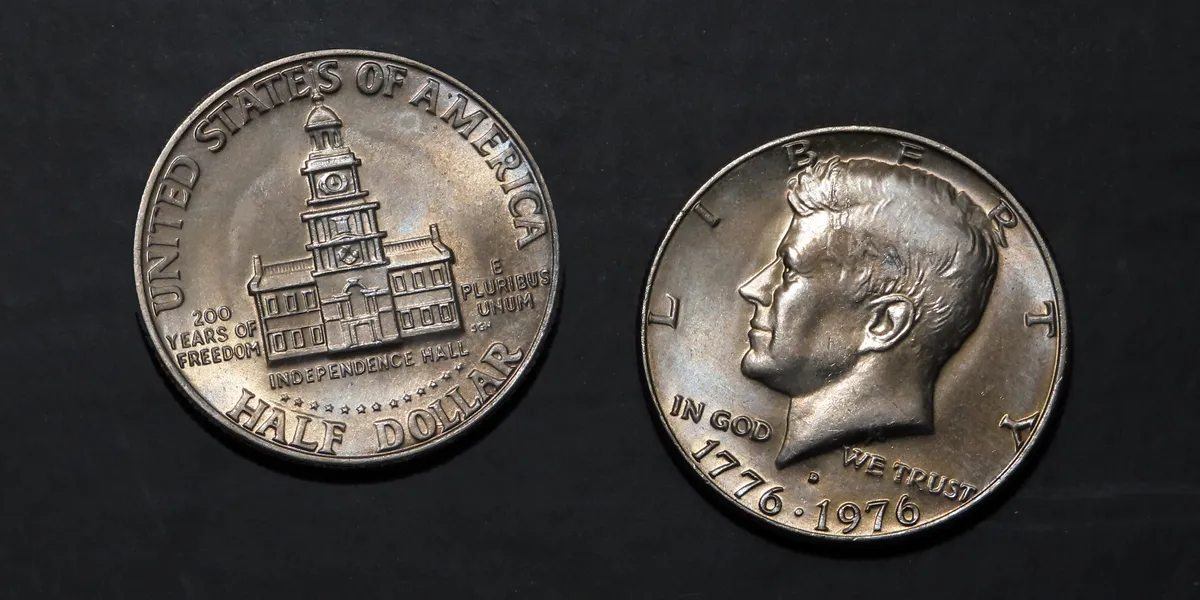
A 1976 half dollar with no mint mark comes from Philadelphia, which struck 234,308,000. A worn one is worth face value. One graded AG-3, worn almost smooth, sold for $70 in 2020, but that is a rare case for a coin in a grading holder.
A 1976-D half dollar has a small D above the date, and Denver struck 287,565,248. A worn one is worth face value too. Near perfect coins are the exception: a 1976-D graded MS-67 sold for $264 at auction in 2025.
A 1976-S half dollar was made in San Francisco for collectors, in two metals. The copper-nickel proofs came in the six-coin proof sets, 4,149,730 of them dated 1976. A 1976-S proof graded Proof-69 Cameo sold for $40 in 2022, and one graded Proof-70 Deep Cameo for $288 the same year.
A 1976-S 40% silver half dollar came only in three-coin silver sets: 4,908,319 uncirculated sets and 3,998,621 proof sets. Three graded MS-68 sold for $65 to $85 in 2021 and 2025. Two silver proofs graded Proof-70 Deep Cameo brought $100 in 2023 and $216 in 2022.
| Year on the coin | 1776-1976 (struck in 1975 and 1976) | en.wikipedia.org |
|---|---|---|
| 1776-1976 halves struck at Philadelphia (no mint mark) | 234,308,000 | en.wikipedia.org |
| 1776-1976-D halves struck at Denver | 287,565,248 | en.wikipedia.org |
| 1976 copper-nickel proof sets (six coins, one 1776-1976-S half) | 4,149,730 | en.wikipedia.org |
| 40% silver uncirculated sets issued (three coins, one 1776-1976-S half) | 4,908,319 | en.wikipedia.org |
| 40% silver proof sets issued (three coins, one 1776-1976-S half) | 3,998,621 | en.wikipedia.org |
| Metal of the everyday coin | Copper-nickel clad: outer layers of 75% copper and 25% nickel over a pure copper core | en.wikipedia.org |
| Weight of the copper-nickel coin | 11.34 g | en.wikipedia.org |
| Diameter | 30.6 mm | en.wikipedia.org |
| Where the mint mark is | On the front, above the date. No mint mark means Philadelphia | en.wikipedia.org |
| Back design | Independence Hall, by Seth Huntington | en.wikipedia.org |