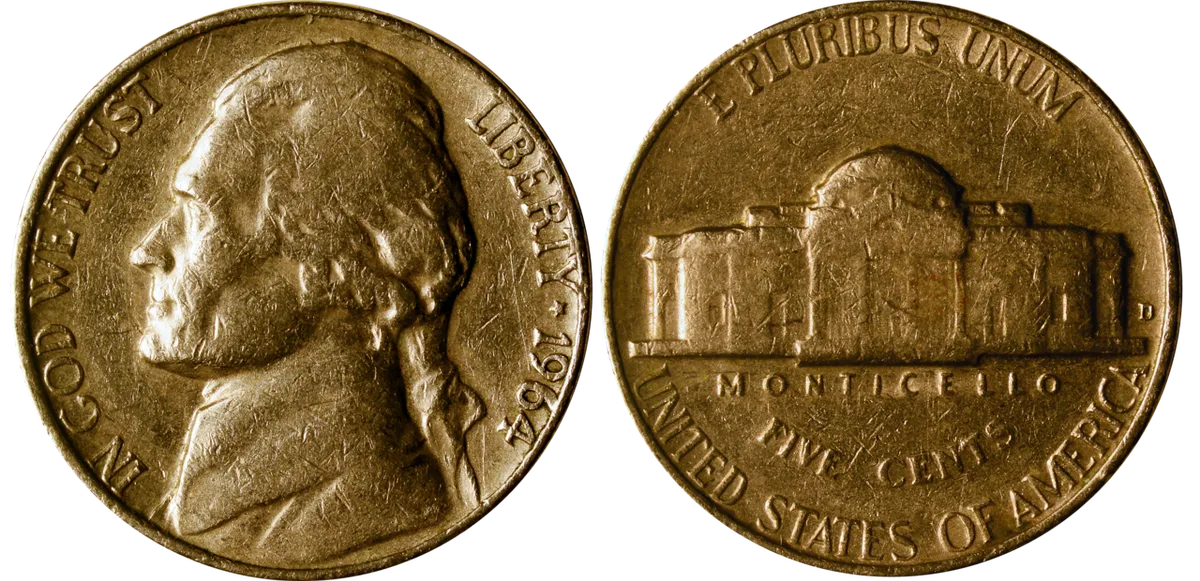
A 1964 nickel with no mint mark comes from Philadelphia, which struck 1,028,622,762 of them. Worn ones are worth five cents. In mint state, a 1964 graded MS-65 sold for $45 at auction in 2025. With full steps on Monticello, the price jumps: an MS-65 brought $145 in 2025 and an MS-67 brought $5,040 in 2021.
A 1964-D nickel has a small D on the back, to the right of Monticello. Denver struck 1,787,297,160, more than Philadelphia. A 1964-D graded MS-66 sold for $30 in 2019 and one graded MS-66+ for $85 in 2025. A 1964-D graded MS-65 with full steps brought $1,140 in 2021, and an MS-66 with full steps and a mirror-like shine $1,680 in 2025.
A 1964 proof nickel was made for collectors at Philadelphia and has mirror-like fields and no mint mark. The Mint stopped striking proofs after 1964, during the coin shortage. A 1964 proof graded Proof-67 sold for $80 in 2017, and one graded Proof-69 Deep Cameo for $172 in 2012.
The highest price for a 1964 nickel on this page went to a special mint set strike, a coin made for collectors and not found in change. That 1964 nickel, graded Specimen-68 with full steps, sold for $31,200 in 2021. If your 1964 nickel came out of a pocket or a jar, it is not one of these.
| 1964 nickels struck at Philadelphia (no mint mark) | 1,028,622,762 | en.wikipedia.org |
|---|---|---|
| 1964-D nickels struck at Denver | 1,787,297,160 | en.wikipedia.org |
| Metal | 75% copper, 25% nickel | en.wikipedia.org |
| Weight | 5.000 g | en.wikipedia.org |
| Diameter | 21.21 mm | en.wikipedia.org |
| Where the mint mark is | On the back, to the right of Monticello (1938 to 1964). No mint mark means Philadelphia | en.wikipedia.org |